Spirituality and Sexuality

Rhiannon C. Beauregard Licensed Marriage and Family Therapist & Supervisor AASECT Certified Sex Therapist & Supervisor ‪(512)-765-4579‬

Spirituality and Sexuality

Rhiannon No Comments

Professionally and personally, I have become increasingly interested in the intersection of spirituality and sexuality.  My clients and their lives, therapeutic processes, and recovery have also guided me to venture down a path to explore the relationship between spirituality and sexuality.

Recently, at the Texas Association of Marriage and Family Therapy Annual Conference, I attended a presentation by Dr. Warren Holleman, LMFT, a behavioral science professor at the University of Texas MD Anderson Cancer Center entitled “Spiritual Dimensions of Family Therapy”.

Spiritual Dimensions

spirituality photo

What does he mean by spiritual dimensions?  When we talk about spirituality we mention themes such as mystical, ehtereal, otherworldly.  Dr. Warren Holleman would define spiritual dimensions as “the deepest meanings and values by which people live”.

Spiritual Awareness

Dr. Holleman further explains about spiritual awareness:

  1. Spiritual awareness is what enables us to treat other people as persons, with dignity and respect.  Not as things or objects.  Not as items on our to-do list.  Treat people as I’s and Thou’s and not people as it.
  2. Spiritual awareness is what enables us to be fully present, wherever we are.
  3. Spiritual awareness helps us get comfortable with silence.
  4. Spirituality is not about blind obedience to religious authority or acceptance of cultural traditions.  Its about being aware, intentional, and often courageous in challenging the status quo.

What struck me about this list (and there were more, I just couldn’t type fast enough!) was that what you get from spiritual awareness is exactly what you need to have good, connected, satisfying, and intimate SEX!

So, this connection between spirituality and sex goes deeper.  Could a person resolve sexual issues, establish a (more) positive sexual identity, improve sexual performance and increase sexual satisfaction by developing themselves spiritually? 

spirituality photo

Spiritual Needs vs. Sexual Needs
Below is a list in Dr. Holleman’s handouts about concepts and needs related to spirituality.  As I read through the list below, I felt that most of these words could also describe the concepts and needs related to sex and intimacy.

Meaning
Love
Compassion
Self-care
Dignity
Community
Wholeness
Holiness
Connectedness
Stewardship
Solitude & Silence
Mindfulness
Serenity
Joy
Wonder
Gratitude
Righteousness
Healing
Integrity
Marriage
Generativity
Nature
Art
Stories
Prayer
A Vocabulary
Faith

I think what came to mind to me was how spirituality has many of the same needs and concepts of our sexual lives.  In general, we might not think of these needs in WHAT we get out of our sexual and intimate relationships, but rather what we would LIKE to get out of our sexual and intimate relationships.  One would hope that they could describe their sexual identity or sex life as having meaning, full of love, being compassionate, increasing a sense of wholeness and connectedness to your partner.  What a gift it would be if you could describe sex as a artful and joyful.  Intimate and connected sex leaves you with feelings of serenity, joy, wonder, gratitude, and healing.  Sex and intimacy shared in community with your partner or marriage is a beautiful and dignified expression of stewardship and role modeling to future generations.

What about masturbation as an act self-care in in silence and solitude, an opportunity to be connected to oneself and ones sexuality?

I also thought that if you were seeking any of these above concepts in sex and intimate relationships, and on the path to find this, perhaps it would be helpful to focus on exploring the spiritual part of your life.

Could the lack of spiritual awareness be affecting your sex life?  12-Step Groups believe that due to the a “spiritual void” in ones life, an addiction, compulsive, problematic behavior is created to fill it.  Only by connecting spiritually to a higher power, is it believed that one can resolve their addiction or compulsion.  Is it possible that if you are spiritually disconnected that it could be contributing to your sexual connection?

So seeing as many of us seek (or might now after this blog) sexual experiences that have all these spiritual characteristics, could it be just as valuable to explore the clients spiritual sides of themselves as their sexual side of themselves?

Developing Spiritual Awareness

When I begin working with someone, one of the first things I want to assess is how religion, spirituality, faith and God are present in your life.  Usually it is helpful for a client of mine to journal or discuss the answers to the following questions within the first few sessions:

What is the importance of religion and faith in your life?
What is your view and experience of God?
What is your experience of faith?
What is your experience in their faith community?
What is your faith community’s view of one who seeks help of a therapist?

This provides me with the framework on how to move forward attending to the spiritual aspect of a clients life.  If someone is struggling with a sexual issues, and through assessment and conversations it comes to appear that that the client is lacking a sort of spiritual awareness or “spiritual intelligence”, it may be appropriate to begin to work on this area for the client.

Dr. Holleman provides a great framework on developing spiritual intelligence and below are some great questions the client may want to begin working on in order to develop their spiritual intelligence.

Spiritual Intelligence (adapted from Daniel Goleman’s Emotional Intelligence)

1. General Spiritual Awareness
What are the spiritual needs and values of individuals, families, and communities?
What are the spiritual dimensions of living and dying, working and playing, health and healing?
What are the spiritual dimensions of human relationships, including families, friendships?
What are the roles that religious stories, practices, and institutions play in addressing the spiritual needs of individuals families, cultures, ethnicities, and economic classes?How does religious language, practices and institutions sometimes make it harder to identify and address spiritual needs and values?
What is the role that helping professionals play in addressing the spiritual needs of individuals, families, cultures, ethnicities and economic classes?

It’s important to have general spiritual awareness in order to have spiritual self-awareness.

2. Spiritual Self-Awareness
What are your own spiritual needs?
What ways do you address (or fail to address) your spiritual needs?
What are your spiritual weaknesses, blind spots, and “hot button” issues?

It’s important to have spiritual self-awareness in order to manage your spirit and recognize the spirit in others.

3. Managing My Spirit
Do you take time outside of work to address your own needs, including your spiritual needs?
Are you comfortable enough with who you are and where you are in your journey that in the interactions with others you 1) don’t drag them into your journey, 2) don’t use them as a means to your ends, 3) are fully present with them, 4) are fully respectful of others spiritual needs, values, and journey?
Are you able to establish appropriate connections and appropriate boundaries around spiritual issues?

Managing your spirit is essential for recognizing the spirit in others.

4. Recognizing the Spirit in Others
Are you aware of the spiritual needs and values of others, from their perspective?
Are you aware of how each individual addresses those needs?
Are you aware of the extent to which individuals understand his or her problems in spiritual terms, as having spiritual dimensions and implications, and as having spiritual solutions?

Recognizing the spirit in others is important for empathy and the ability to address spiritual needs of others.

5. Addressing the Spiritual Needs of Others (Likely for helping professionals, spiritual guides, spiritual leaders)
Are you able to empathize with the spiritual sufferings and joys of others?
Are you able to recognize which spiritual needs and values are relevant to others problems?
Are you able to help others identify or clarify their spiritual needs?
Are you able to help others address their relevant spiritual needs?Are you able to utilize others religious beliefs, experiences, and terminology in talking with them?
Are you able to help clients overcome the confusion and work through the pain that are sometimes caused by religious beliefs, experiences, and terminology?
Are you skilled in using spiritual tools such as spiritual reframes, religious resources, and spiritual rapport?
Are you skilled in rolling with religious resistance?
Are you skilled in recognizing and addressing spiritual abuse?

There are many other ways to develop spiritual intelligence, including story telling, prayer, meditating/mindfulness, and reading any of the below resources.  More will be written about in future blogs but those are just a few suggestions to start.  If you are seeking out a therapist who is open to exploring spirituality, sexuality, and their intersection in your life, please feel free to contact me using the form below.

Other resources:

Mans Search for Meaning by Viktor Frankl

Does God Exist: An Answer for Today by Hans Kung

Amazing Grace: A Vocabulary of Faith by Kathleen Norris

Emotional Intelligence: Why It Can Matter More than IQ by Daniel Gol

S21: The Twenty-One Skills of Spiritual Intelligence by Cindy Wigglesworth

Spiritual Intelligence: A New Way of Being by Brian Draper

The Future of an Illusion by Sigmund Freud

Spiritual Resources in Family Therapy by Froma Walsh

When Things Fall Apart: Heart Advice for Difficult Times by Pema Chodron

Chi Walking: The Five Mindful Steps for Lifelong Health and Energy by Danny and Katherine Dreyer

Peace is Every Step: The Path of Mindfulness in Everyday Life by Thich Nhat Hanh

True Love: A Practice for Awakening the Heart by Thich Nhat Hanh

Search Inside Yourself: The Unexpected Path to Achieving Success, Happiness, (and World Peace) by Chade-Meng Tan

Care of the Soul: A Guide for Cultivating Depth and Sacredness in Everyday Life by Thomas Moore

Theology of the Body by Pope John Paul II

Medical Food for Sexual Functioning

Rhiannon No Comments

“FOOD IS MEDICINE” says Dr. Michael Lara, a physician in private practice from San Francisco in his seminar on “The Pharmacy in Your Kitchen: An Overview of Medical and Medicinal Food”.

“Let food by thy medicine and medicine be thy food” – Hippocrates

The content in this blog is based on information gathered from the above titled seminar that took place on Thursday February 18, 2016.  Most of the information presented in this blog was acquired from the presentation and accompanying materials.  If you have any questions about what is written here, please feel free to contact me directly or connect with Dr.Michael Lara through Facebook: www.Facebook.com/BrainMD and his website: www.drmikelara.com.
Please be sure to check with a qualified health professional before implementing any medical or medicinal food protocol.  Food is medicine and also has a potential to harm.  It’s important to include your health care provider(s) in the conversation to keep you safe and maximize benefit.  

87% of Americans believe that certain foods have health benefits that go beyond basic nutrition.  But most doctors and physicians don’t think of medical foods when discussing health concerns and treatment options with their patients.  I signed up for the seminar to see what the options are out there for my clients when dealing with sexual concerns as well as other health conditions, like depression, insomnia, and chronic pain.

What is a medical food?
The FDA defines Medical Food as “A food which is formulated to be consumed or administered enterally through the supervision of a physician and which is intended for the specific dietary management of a disease or condition for which distinctive nutritional requirements, based on recognized scientific principles, are established by medical evaluation.”

Medical foods aren’t regular foods, but rather the dietary products formulated for the management of diseases for which specific nutritional requirements have been established.  They aren’t drugs or dietary supplements and are monitored separately by the FDA. All efficacy claims for medical foods must be based on recognized scientific principles and clinical data and medical foods may be used only under medical supervision (but may or may not require a prescription).

Medical foods are different than supplements and drugs, and are regulated by the FDA.

The purpose of this blog is to discuss the use of medical and medicinal foods in relation to sexual functioning as well as other conditions that my clients present with.

Medical Foods and Mechanisms of Actions

Medical foods affect three mechanism of actions: neurotransmitters, inflammation, and nutrient metabolism.  While much of the research presented deal with conditions related to diseases such as Alzheimers, osteoarthritis, and insulin resistance, medical foods also address sleep issues, depression, pain, inflammation, chronic pain, neuropathy, and metabolic issues.

The mechanism of action that I found very interesting and relevant was medical foods that alter neurotransmitter levels.  One of the biggest challenges I have as a sex therapist is working with clients who have various mental health concerns such as anxiety and depression who take psychopharmaceuticals to address the anxiety and depression.  They often present with sexual issues related to the anxiety and depression AND/OR the side effects related to taking psychopharmaceuticals to treat the anxiety of depression.  We sometimes feel very stuck when trying to address the sexual issues while at the same time effectively managing the anxiety, depression, or other health concern.

Medical Foods and Depression

Medical foods that affect neurotransmitters can offer options to address depression without the side effects to sexual functioning.depression photo

Deplin (L-Methylfolate) is a medical food for patients with treatment-resistant depression.  While Deplin may require a prescription, L-Methylfolate can be purchased over the counter.  L-Methylfolate improves depression and reduces markers of inflammation.  And even more interesting is that there are tests that can be done (and more and more mainstream doctors are having patients have these tests) that can tell you whether you are deficient in some of these areas.   Dr. Lara recommends the company 23 and Me for genetic testing to see if you have deficiencies in areas that could benefit from targeted treatment based on the results.  .

Dr. Lara presented extensively on curcumin (found in spice tumeric and mustard) which can have anti-depressant effects via MAO Inhibition as well as other positive benefits.

Medical Foods and Sleep Issues

MANY of my clients struggle with sleep issues, and medical foods might provide an alternative to sleep medications that might have unpleasant side effects, be highly addictive, quickly increase tolerance, and diminish the quality of your general sleep.  A medical food that may work on sleep issues through acting on neurotransmitters is Gabadone.

Medical Foods and Sexual Functioning 

While I wish Dr. Lara spent more time discussing the benefits of medical foods for sexual functioning (even if just periphery, like, how a medical food can reduce inflammation, possibly inflammation in the genital region due to issues that cause sexual pain, or how medical foods can affect the neuropathy of sexual organs), he did spend some time talking about the benefits of Cocoa and Maca.

Cocoa is derived from the trees and considered the”drink of the gods” and is  rich in anti-oxidants.  Dr. Lara made it clear that he wasn’t talking about Milk Chocolate (and a groan ensued from the crowd) but dark, unsweetened 70%+ cacao.  Optimal dose is 10 grams a day.

Maca is a plant that grows in central Peru in the high plateaus of the Andes mountains. It has been radish photo harvested as a vegetable crop in Peru for at least 3000 years. Maca is a close relative of the radish. Maca has been linked to helping with low desire, sexual dysfunction, erectile dysfunction, hormonal issues, symptoms of menopause, and menstrual problems.   To be clear, Maca is not a medicinal food, but when combined with cocoa, it can have medicinal affects.  Maca Cocoa a libido-enhancing antioxidant drink.  It also can reduce the effects of menopause without affecting the hormones and has been reported to increase the subjective feelings of well-being.  

Natural Food Sources

While there are several products that can provide some of the medicinal foods to you, it has been stated that the best way to get some of these medicinal foods is through actual FOODS!  A great resource to see how much a food has of what you are looking for is the USDA National Nutrient Database for Standard Reference (http://ndb.nal.usda.gov/),  The website is a great way to find natural sources of nutrients mentioned above in your food.

Working With Practitioners That Can Help You 

Dr. Lara stated that most doctors don’t prescribe or recommend medical food because they don’t know about them.  If you are interested in learning more about medical food, especially medical food for sexual functioning, you will want to seek out one of the following providers who are trained and educated on using medical foods for sexual functioning (or just general use): Naturopaths, Osteopaths, and Functional Medicine Doctors are all trained and educated in working with supplements and medical foods.  You can find information on these practitioners at the following websites:

Institute for Functional Medicinehttps://www.functionalmedicine.org
American Association of Naturopathic Practitionershttp://www.naturopathic.org
American Osteopathic Association: https://www.osteopathic.org/

Overall, the presentation was well-done and informative, although there wasn’t a whole lot of information presented about sexual functioning.  But very valuable information that is relevant to my work is how there are a multitude of options around medical food and insomnia and depression, which are often confounding conditions that affect my clients.  Medical foods may offer options to many clients with a variety of medical issues that could be effective in treating their condition while reducing or eliminating the sexual side effects of the issues themselves (one of the hallmark symptoms of depression is low sexual desire) and psychopharmaceuticals and other drugs.  While there really isn’t a lot of data on the efficacy of medical food for sexual functioning, its a growing area that has a lot of fascinating implications.   Definitely worth asking your healthcare provider about.


Online Sex Therapy In Texas

Rhiannon No Comments

As I prepare a presentation for the 2016 Texas Association of Marriage and Family Therapy (TAMFT) Annual Conference in a few weeks in San Antonio, TX, I wanted to write my second blog in the series related to the locations that I serve about Online Sex Therapy in Texas.

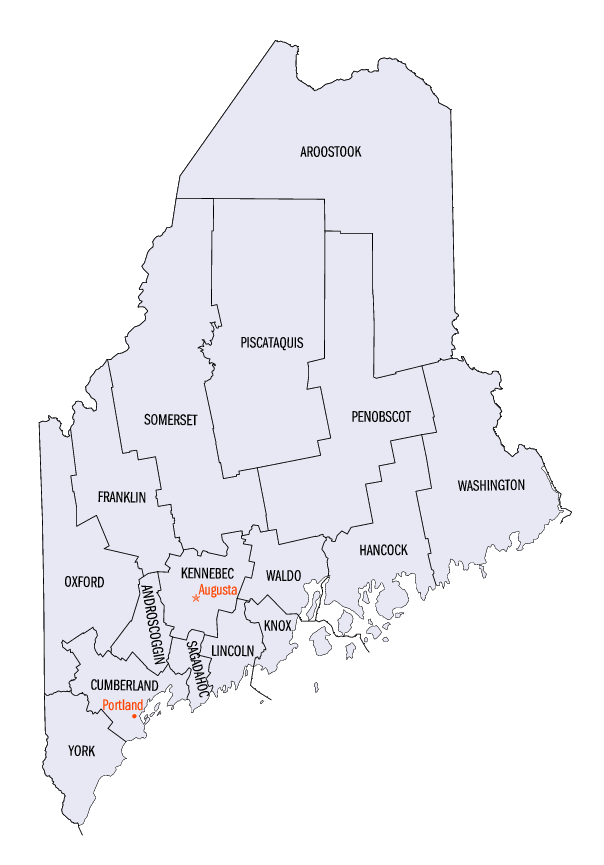
SexTherapy-Online, PLLC is an online sex therapy and sex counseling practice that serves the residents of Maine, Massachusetts, New Hampshire, New York, and Texas.  Each state that I work in has a unique population to serve and unique issues facing the residents and the state as a whole.

This blog will discuss my personal ties with Texas including some of the places I have traveled within the state as well as a paragraph or two about the sexual issues and concerns facing Texans and any unique trends or considerations around sex and intimacy specific to Texas.  Saddle up, because we are about to go on a cattle drive to the beautiful state of Texas!

texas photo

My “brief” history with Texas

Out of all the states I work in, I have the shortest history with the state of Texas.  I moved to Austin, TX in 2014 for a few different reasons but mostly because I was looking for a place where I could avoid the harsh Northeast winters and I wanted to live in a city that was interesting, rich with culture, politics, and things to do, and that was accessible to the other half of my life: horses.  Since I have lived in the state of Texas for less than two years, I haven’t had a ton of time to get around but I will share some of my travels.

My first introduction to Texas was in March, 2014 when I attended the Equine Assisted Growth and Learning Association (EAGALA) Annual Conference which was held in Mesquite, TX (right outside of Dallas).  I enjoyed a few trips into Dallas over that weekend and loved this mix of urban and cowboy.  On that same trip, I enjoyed the Stockyards in Fort Worth, did some line dancing at Billy Bob’s, and ate WONDERFUL steak!  On my first visit, I kind of felt that Texas was like living in another country (says the Yankee!).

When I moved to Texas, I drove down from the Northeast so I got to see a small amount of the Eastern and Central parts of the state driving through.  Cities like Texarkana, Marshall, Longview, Tyler, Athens, and Corsicana gave me my first introduction to East Texas and cities like Waco, Temple, Belton, and other cities along I-35 gave me a taste of how BIG Texas really is.

While home base is Austin, TX, I travel at least once a month to San Antonio for a variety of reasons.  I like San Antonio’s vibe and happen to have a lot of business related things going on in San Antonio.  I also like the Alamo and the Riverwalk and have also been to several concerts at the Alamodome (have yet to go to a soccer game but hope to soon!).  I often head North too, to places like Waco, Belton, Temple, Round Rock, Cedar Park, Leander, Pflugerville, and Georgetown for various events, concerts, and I’ve even worked in very picturesque and rural areas such as Goldthwaite.  There is this great little diner in Goldthwaite, called the Wagon Wheel Restaurant.  Best hash brown you ever will have and a trip out there will bring you through sleepy, rural Texas town after sleepy, rural Texas town, all built alongside the Gulf, Colorado, and Santa Fe Rail line.  These little towns are what  I think of when I think of a rural Texas town (tumble weeds and all).

Austin is located in Central Texas or the Hill Country of Texas.  While I thought Texas was this dry, flat, desert-type landscape, I couldn’t have been more wrong!  Austin is in an area that has rolling hills and diverse natural landscapes.  A LOT of lakes, rivers, creeks, and streams, making swimming and recreating super easy and accessible.  While we are prone to drought, overall, Austin sits on a few aquifers that make the area always seem like it has water (even if we don’t!).  With great wineries, distilleries, and breweries in towns like Driftwood, Dripping Springs, Wimberley, and the rest of the Hill Country, it is a great place to visit and relax.  And don’t get me started on the barbecue.

In East Texas, I have attended several EAGALA trainings in the Tyler, TX area (Whitehouse, TX to be specific), right on Lake Tyler.  That’s a beautiful area that is also rich in history.  I always like driving out of Central Texas and seeing the differing landscape that East Texas has to offer.  I never knew how many lakes were in Texas (they have the most square mileage of inland water of any state).

I have family in Houston, so I spend some time in that area relatively frequently.  Also, many conferences and trainings are in Houston so I am gradually exploring the most populous city in Texas and the fourth most populous city in the country.  I have many clients that work in the oil and gas industry who mostly are based in Houston and due to their travel and busy schedules, they find having an online therapist very convenient.

My favorite outdoors  Texas pastimes are exploring the vibrant flora and fauna of Texas and I enjoy camping (year round!) and going on Texas adventures with my horse.  I have plans to head over to West Texas and the Border this summer to go camping and exploring in Big Bend National Park and the town of Terlingua.  I still would love to do more exploring of West and North Texas as I put down roots in the rocky, often dry, soil of the Texas Hill Country.

Sex Therapy in Texas Considerations

Geographical Challenges
Texas has some challenges similar to that of Maine with it’s shear size and distance between cities and towns.  Texas is a HUGE state, and I’d say it isn’t uncommon for a Texan to take a short 2-3 hour trip just because in Texas 2-3 hours is a short time to get somewhere!  Unless you live in a city, you are likely to have to travel long distances for specialized care like sex therapy, making it expensive and time-consuming to receive sex therapy.  And, if most therapists work during the week, you would likely need to take a day off from work if you need to travel 3 hours one way to go to your closest sex therapist, which makes sex therapy something you would not frequently be able to attend since it is so time-consuming due to travel.  And add trying to tie in your partner or spouses schedule, and the shear thought of another appointment during the week might stop you right in your tracks.  Many of my clients are all over the state because they just can’t swing going to a sex therapist in person.

Rural Population
Texas has the nations largest rural population with over 3.6 million rural residents (as of 2000, and that was 16 years ago!) so geographically, over 3.6 million people live in rural areas that might have to travel a long distance for therapy.

Working with a rural population also poses unique challenges to a sex therapist.  Many rural folks aren’t comfortable or accustomed to talking to others about sex, and since poor communication and knowledge about sex and sexual issues could be a factor that contributes to developing sexual issues, dysfunctions, compulsions, or problematic sexual behavior, one could deduce that these factors can contribute to a high incidence of sexual issues in rural populations.  So, high incidence with lack of accessible services creates a gap for rural Texans.  A very large gap!  Lucking, SexTherapy-Online, PLLC provides accessible online sex therapy and sex addiction therapy services to rural Texans.

Political Considerations
Politically, Texas is a pretty conservative state and hasn’t been known to support sexual topics or issues in the political sphere or as a general life concern.  This adds unique challenges to being a sex therapist and providing sex therapy to clients who live in a culture that isn’t very supportive politically of sexual issues and agendas.  I’ll leave it at that because I don’t professionally publicly take any stance about the political issues facing the sexual landscape of Texas but it does pose a challenge in being a sex therapist and providing quality and accessible services to Texans.

Finding a Sex Therapist
Finding a sex therapist is hard enough to do, but imagine if your state had 254 counties!  How do you go about looking for a sex therapist in your area, and if not in your area, how do you go about just searching for one in a vicinity of 2-3 hours away.  Us sex therapist don’t post advertisements in the local newspaper, so it’s often difficult to find someone that specializes in the services you need.  And this isn’t addressing whether or not they are a good fit for you.  By offering sex therapy and sex addiction therapy services online, SexTherapy-Online, PLLC is accessible to Texans no matter where they are in the state and hopefully this blog will increase the accessibility on the internet as well so that Texans from any part of the state can find an online sex therapist in Texas easily by searching online.

Cultural Considerations
Another interesting aspect when working in the field of Sex Therapy with Texans is the different cultures in the state of Texas and their differing views of sex and sexuality.   Texas has a rich and diverse history, with six national flags flying over the state in its history (interesting fact: Six Flags the amusement park chain was founded in Texas and named exactly for this reason!).  The six flags that have flown over Texas are: Spain (1519–1821), France (1685–1690), Mexico (1821–1836), the Republic of Texas (1836–1845), the Confederate States of America (1861–1865), and the United States of America (1845–1861; 1865–present).  Taking a look at all these cultures (and thinking about other immigration trends of Germans and Central Americans to name JUST two), there are a LOT of cultures present in Texas.  With each culture having its own views on sex and sexuality, there is definitely a very active melting pot of cultures to work with in sex therapy.  I have a diverse cultural background and always aim to be culturally competent, sensitive, and curious in my approach when working with different cultures around sex.

Religions and Texas
Texas has also been declared one of the nations most religious states.  The chart below shows the breakdown in 2010 (in millions) of the religious bodies that adherents (“Adherents” includes full members, their children, and others who regularly attend services) associate with. 

Religious Body Adherents Percent ot Population
Year 2010 2000
1. Catholic Church 4,673,500 18.59   20.95
2. Southern Baptist Convention 3,722,194 14.80   16.88
3. Non-Denominational Christian 1,546,542 6.15  
4. United Methodist Church 1,122,736 4.46   4.90
5. Muslim estimate 421,972 1.68   0.55
6. Church of Christ 351,129 1.40   1.81
7. LDS (Mormons) 296,141 1.18   0.75
8. Assembly of God 275,565 1.10   1.09
9. Presbyterian Church (U.S.A.) 155,046 0.62   0.86
10. Episcopal Church 148,439 0.59   0.85
11. Lutheran–Missouri Synod 132,508 0.53   0.67
12. Lutheran–E.L.C.A. 111,647 0.44   0.74
         
Unclaimed by any faith 10,103,455 40.18   38.25

Research has shown a relationship between religiosity and sexual performance and sexual satisfaction and I have seen a relationship between religion and religiosity and sexual issues, dysfunctions, and problematic behavior in my clients.  Religion is always a factor to explore when working with Texans in a sex therapy context.  As a certified sex therapist, I attend to and integrate spiritual and religious beliefs with all my clients in their treatment of a sexual concern (even if those beliefs are atheist, agnostic, or other).   This wasn’t something that I always felt came natural to me as a clinician, as growing up in the Northeast, religion and spirituality often fell on the back burner when it came to clinical interventions.  But the more I work in the field of sex therapy, the more I am experiencing and learning that clients spiritual and religious beliefs play a huge role in their sexual identity.

Interestingly enough, the above chart shows that over 10 million people and over 40% of the population in Texas are unclaimed by any faith, which is also a consideration.  Many of my clients present spiritually wounded or spiritually distracted and part of their therapy is working on resolving their spiritual and religious wounds and creating a life that has a spirituality that is meaningful to them.

Access to Sex Therapists
According to the American Association for Sex Therapists, Counselors, and Educators (AASECT), there are 37 AASECT-certified sex therapists, counselors, and educators in Texas, with 6 being in San Antonio, 8 being in the Houston Area, 10 in the Dallas/Fort Worth area, and 8 being in the Austin area.  That leaves around five existing in areas outside of one of the major Texas cities.   That isn’t  lot.

For those that specialize in sex addiction, there are more options, with www.IITAP.com listing 135 CSAT (Certified Sex Addiction Therapists) in Texas.  however, it is unclear how many of these While I am not a Certified Sex Addiction Therapist through IITAP, I have extensive experience and training working with those that have sex addiction or compulsive sexual behavior and am highly qualified to work with clients with compulsive sexual behavior and sex addiction.

Places where you can look to find a qualified sex therapist or sex addiction therapist are below:

Certified Sex Therapists, Counselors, and Educators can be found at the American Association for Sexuality Educators, Counselors, and Therapists (AASECT).

Certified Sex Addiction Therapists can be found at the International Institute for Trauma and Addiction Professionals (IITAP).

Professionals that specialize in sex addiction, sexual compulsivity, and sexual health can be found at the Society for the Advancement of Sexual Health (SASH).

If you are located in the states of Maine, Massachusetts, New York, New Hampshire, and Texas, please find my contact information below.  I love being a Texan and an Austinite and am honored to help all Texans with their sexual concerns.

American Association for Sexuality Educators, Counselors, and Therapists (AASECT)


Online Sex Therapy in Maine

Rhiannon No Comments

This is the first of a five-part blog series about the locations that SexTherapy-Online regularly serves. SexTherapy-Online is an online sex therapy and sex counseling practice that serves the residents of Maine, Massachusetts, New Hampshire, New York, and Texas.  Each state has a unique population to serve and unique issues facing the state.  This blog series will discuss each state in detail.

I’m kicking off the New Year and this new blog series with the beautiful state of Maine.  Each blog will discuss my personal ties with the state including some of the places I have traveled within the state as well as a paragraph or two about the sexual issues and concerns facing Mainers and any unique trends or considerations around sex and intimacy specific to Maine.  Pack the car and the cooler and buckle up, because we are about to go on a road trip to the beautiful state of Maine!

My Long History with Maine

My relationship with Maine isn’t just as an online sex therapist serving the residents of Maine.  I grew up vacationing in Maine in a family cottage off of Shore Road in Ogunquit, Maine in York County.  My family has owned the small one-room beach cottage (that eventually got renovated by my father and uncles in the 70’s to be a two bedroom vacation cottage) and the land surrounding it for over a century.  While some of the land has since been sold off, the cottage and the traditions still exist and the cottage still is within the family.  Every few years or so I stay in it off season to enjoy the Maine winters (briefly of course!) and visit in the Summer to enjoy the true fruits of Vacationland!  I still have family that lives in York and spend summer vacations in Southern Maine and Phippsburg in Sagadahoc County.

I still frequent Eliot and Kittery often when I am in the Northeast and have several friends who live and work in downtown Kittery, what a new a vibrant hub Kittery Foreside is becoming!  I love the history of the Portsmouth Naval Shipyard and the Isle of Shoals.

Acadia National Park (the second most visited National Park in the United States) in Hancock County is still one of the most breathtaking National Parks in the United states and I hiked and camped there as a child.  I also used to show my horse at Maine International Morgan Horse Show in Bangor in Penobscot County in the 1990’s, but that horse show has since moved to New Hampshire (which I showed there in 2012 and 2013).  Each year, my family and I also head to Freeport in Cumberland County for some holiday shopping and we enjoy  the L.L. Bean flagship store, which is open 24-hours-a-day, 365 days a year.

I love Mainers, and the state of Maine.  It’s a unique and quirky place, with a rich history and geography and an even richer demographic.  It’s size and diversity of living areas make it challenging for the residents of Maine to have access to sex therapy services.  SexTherapy-Online can help bring high quality sex therapy to the residents of Maine, no matter how close they are to a city like Portland, Lewiston, or Bangor.

Sex Therapy Challenges in Maine

Maine-counties-map

Most people don’t realize the shear size of Maine.  Maine is roughly the size of ALL of the New England states COMBINED.  Maine has sixteen counties, with Aroostook County, at 6,453 square miles, covering an area greater than the combined size of Connecticut and Rhode Island.  Maine’s largest city, Portland in Cumberland County, the largest city, only has less than 70,000 people (according to the 2014 Census) and Maine only has a total population of 1.3 million.  While Maine is the least populated state that I work in, it is the most underserved with the least amount of Certified Sex Therapists out of any of the states I work in.

While the size of Maine, the population, and the lack of qualified and certified sex therapist pose unique sex therapy challenges for residents of Maine, geography also is a factor to consider.  Maine has a diverse geographical landscape.  There is the Lakes and Mountains Regions that includes Bethel, Bridgton, Harrison, Eustis, Stratton, Farmington, Fryeburg, Jay, Livermore, Livermore Falls, Kingfield & Carrabassett Valley, Lewiston, Auburn, Naples, Norway, South Paris, Rangeley Lakes, Rumford, and River Valley.  Very rural and at times a little challenging to get to, online sex therapy offers a convenient option for sex and sex addiction therapy for the residents of Oxford, Franklin, Somerset, Androscoggin, and Kennebec Counties.

Maine is home to over 3166 islands, both fresh water and ocean islands.  While many are small or uninhabitable, many people live on these islands and either access the island by public ferry or by private boat.  Downeast Acadia Islands like Mount Desert Island, which includes Bar Harbor, Eden, Hulls Cove, Salisbury Cove, and Town Hill; Mount Desert, with the villages Northeast Harbor, Otter Creek, Pretty Marsh, Seal Harbor, Hall Quarry, and Somesville; Southwest Harbor, with the villages of Manset and Sewall; and Tremont, with the villages of Bass Harbor, Bernard, Gotts Island, Seal Cove, and West Tremont, Beals, Great Cranberry, Little Cranberry, Frenchboro, Swan’s Islands.  Midcoast-Penobscot Bay Islands including Isle au Haut, Islesboro, North Haven, Squirrel Island, Vinalhaven and Fox Islands, Monhegan, Matinicus, and Criehaven.  Lower Midcoast-Muscongus Bay Islands including Hupper Island and Oar Island and Casco Bay Islands including Chebeague Island, Cousins Island, Cliff Island, Great Diamond Island, Peaks Island, Long Island, and Cushing Island, just to name a few (PHEW!).  And one can imagine, it’s not that easy to get to the sex therapy regularly when you have to take a ferry to the mainland!  Islands add a unique consideration on accessing quality sex therapy and sex addiction services in Maine.

And speaking of difficulty traveling, the average annual snowfall in Maine is 50 to 70 inches in the Coastal Division, 60 to 90 inches in the Southern Interior and 90 to 110 inches in the Northern Interior. That’s a LOT of snow!  In fact, in February 2015, Eastport, ME in Washington County set a statewide snow record for 76″ of snowfall in a 10 day period!  Eastport is the most easternmost city in the United States and consists entirely of islands.  It’s not easy to get to your sex therapist when you have 76″ of snow out your door AND you live on an island!  This makes Maine a very unique state to practice sex therapy in!

Sex Therapy with Mainers

My Aunt mentioned over the holidays that in order to be considered a true “Mainer” you need to not only live in Maine or be from Maine, but you have to have “three generations in the ground”.  Assuming this means at least three generations have lived and died on Maine soil, that is a pretty tall order!  Mainers are hearty, strong folks with strong belief systems who are not often raised to be comfortable speaking and sharing about sex and sexuality.  And since many Mainers live in rural areas, they are often isolated from friends, relatives, potential partners, and a diverse social and sexual landscape.

A lack of comfortability in talking about sexual matters and isolation can be risk facts for sexual issues, dysfunctions, and sexual compulsivity and sex addiction, often making folks living in areas like Maine prone to sexual issues.

SexTherapy-Online can help deal with the sexual issues of residents living in Maine.  If you or someone you know is struggling with a sexual issue or sexual compulsivity, please use the form below to contact me.  You don’t have to suffer sexually.  There is help.

I also have some colleagues in Maine that specialize in sex and relationship therapy that I would recommend for in-office therapy.  Dr. Ron Feintech and his staff a The Couples Center in Portland, MA (www.thecouplescentermaine.com) are excellent resources for those struggling with sexual issues in Maine.

And whether you are located in Maine or another state, you can always locate a certified sex therapist using the American Association of Sexuality Educators, Counselors, and Therapists (AASECT) to find a sex therapist in your state: https://www.aasect.org/referral-directory


Stress, Sex and the Holidays

Rhiannon No Comments

Stress is one of the most common contributors to low sexual desire and the holiday season has proven to be one of the most stressful times of the year!  But don’t let holiday stress affect your sex life!  Sex and the holidays do not need to be mutually exclusive events!  Here are some tips to make sure that this holiday season you have less excuses for why not to have sex and more heat in the bedroom, or in front of a warm fireplace, or under the mistletoe or…

1. Plan Ahead

Try to schedule everything.  Around the holidays, our routine goes out the window and as creatures of habit, that immediately sends us into a stress filled tail spin that can spiral to the point of breaking.  Make lists, schedule your week, fit everything in.  If you aren’t usually an agenda or planner person, use one to stay organized during the holidays.  Put your every day tasks that you might forget in the planner in one color and holiday tasks in another color.  Be creative on keeping your self organized, from shops you need to check out to what you are having for dinner.   Use the calendar option on your smartphone to assist with this. Schedule things in advance and do not wait until the last minute.  The term “waiting until the last minute” is in and of itself stressful- just don’t do it!  Scheduling and planning are huge stress reducers.

If you don’t regularly plan sex with your partner, maybe stressful holiday times are a great time to start intentionally setting aside time for intimacy with your partner.  And just because you set aside some time, doesn’t mean you have to have sex.  In fact, pressure to have sex is another desire killer!  Just set aside some time each week (at least once a week) to have some alone time with your partner.  It doesn’t have to be sexual, just close and intimate.

2.  Blow Off Steam

Whatever you put into your body in stress needs a place to leave your body (and screaming at your family members does not count as stress leaving your body).  If stress can’t or doesn’t leave, it can be manifested in muscle pain, emotional distress, gastrointestinal issues, relationship concerns, sleep disturbances, low sexual desire, and/or complete overload.  Make time to de-stress and blow off steam.  Exercise, meditate, do yoga, read, knit, play a musical instrument, walk your dog, do anything to blow of the steam before the tea pot starts to whistle.

Having sex is another way to blow off steam and provided you do not have issues with compulsive or unhealthy masturbation, taking time to be sexual with yourself is also a great way to blow off steam.  Easy on the pornography, or better yet, use your imagination or read an erotic holiday story for a fun holiday sexual fantasy with (or without) your partner!

steam train photo

3. Nourish Yourself

You can’t expect your body to act in top condition if you aren’t giving it the necessary fuel it needs to run smoothly.  Make sure that you still take time to eat healthy food and snacks.  Not traditionally a healthy eater?  Try to give yourself one healthy snack or portion of your meal a day and pack an apple or carrot sticks in your bag before you leave to provide you with a healthy option.  If you are a stress eater, know that you aren’t “rewarding” yourself when you eat unhealthy.

Being sexual with yourself or with a partner can be very nourishing.  Take the time to go slow and enjoy the sensual experience of nourishing yourself (and your partner) sexually.  A fine meal at a nice restaurant is a wonderful form of foreplay and is made to nourish our sensual needs too.

4.  Play and Laugh

All too often, we forget to enjoy the holidays for what they are for: family and friends.  We get so caught up what we need to do or get, where we need to be (5 minutes ago!), and how we need to act.  Let your hair down a bit, kick off your boots, and play with your cousin’s dog, sit with the kids, and tell funny stories.  Playing and laughter will reduce your stress and give you a good recharge to why the holidays can be fun.

And that goes for times in the bedroom too- have fun with sex and recognize that laughter is VERY sexy.  Don’t take things so serious and try new things.  Most couples wish their sex was less serious and more playful!

5.  Redefine

If you walk in the door thinking your holiday dinner is going to be a disaster, the likelihood of it being something different is reduced.  Redefine the holidays as an opportunity to check in with family members, see babies and kids grow, and catch up on big family milestones.  Even if those “disaster” characteristics are present, it doesn’t cost you anything to say silently to yourself: “At least my daughter-in-law has a brain” instead of critiquing her differing political views.  Redefine how you look at the negative aspects of the holidays and challenge yourself in being more positive.

Redefining sex might be long overdue- do you look at sex as a chore, as something you just do to “get it over with”, or something that is necessary to keep your marriage/relationship together?  If any (or all) of these apply, it is definitely time to redefine how you look at sex.  Sex is an opportunity not an obligation.  If this is how you feel, it might be time to contact a qualified sex therapist for assistance.  See information below.

6. Manage Your Finances

Give only what you can, and be okay with that.  Finances are a major source of stress for people and add the holidays in the mix and it can get overwhelming.  Most of us can understand that gone are the holidays in the thousands, and here (to stay it seems) are the holidays where it is more about family and friends than giant presents and extravagant gifts.  The best gift you can give (to yourself and others) is staying within your budget this holiday.

Finances and sex are two of the most common topics couples argue about.  Consult a qualified financial coach to assist you and your partner with managing everyday finances as well as long-term financial considerations.  Set out a plan and stick to it, and recognize the holidays aren’t the best time to address ongoing financial habits (as this is the most vulnerable time for spending).  If you haven’t come up with a plan yet, and are already way over budget, try to do little things to keep the stress off.  Try not to let stress and worry about finances affect your sex life.

7.  Do Good

Even though this is a very stressful time, volunteering your time, donating items, participating in charity events, and helping out others is a great way to relieve stress.  I would recommend doing it in person (even if you don’t feel like you have one more minute to do anything more, make a minute).  You would be surprised how less stress you feel when you give to others and gain a little perspective.

And when it comes to doing good for others, give your partner some extra attention around the holidays.  Perhaps doing something you both don’t do that often, but you know you/they like.  Give to give, not to receive.  No reciprocal intimacy can be very rewarding (and erotic).

8. Accept and Allow

Holidays are often a time when individuals and families have a lot of stress over a loss.  This can be a loss of a family member, a loss of functioning, a loss of a pet, a loss of a job, a loss of relationship, or any other loss.  Because the holidays are a bench mark for the year, it is easy to get into the habit of thinking “I was doing this last year with so and so, and this year… nothing”.  Accept the fact that the holidays are hard and allow yourself (and others) the opportunity to grieve and express their grief.  If this time of year is especially hard, seek out help either from friends and family or from a counselor.

If you are mourning the loss of your intimate partner or intimate life or any loss at all, don’t use sex to replace the actual feeling.  Just feel and move through the feeling.  Real intimacy isn’t about escaping negative feelings, its about processing them and moving forward with them.

9.  Rebuild

Family dynamics.  What are the first words that come to mind?  Stress, anger, resentment, old memories, money?  If these are some words that come up for you, you are like many other families during this holiday time.  But instead of piling on more words to your destructive family relationship pile of negativity, why not take your shovel and scoop off a few from the top this holiday season.  At the very least, don’t add on any more, but I challenge you to try to let go of some of the old resentments you might hang on to because of stressful family situations.  Why should you be the one that has to?  Well you don’t have to, but you are reading an article on how to reduce stress during the holidays so maybe it is in your best interest to be the bigger person and get that shovel out.

If you are holding out resentments towards your intimate partner around the holidays, try to not let it get in the way of intimate time and rebuilding moments with them.  Sometimes, one can find themselves more committed to the resentment than the relationship.  Let go, if you can.

10.  Relax

The holidays can and are fun.  Make your friends and family and fun and food take priority over anything stressful.  Keep everything in perspective and relax and enjoy yourself.  Allowing yourself to relax is sometimes just as difficult as relaxing so take the time you need, a few deep breaths, and smile.

And there is nothing more relaxing than a steamy, sexy night with your partner (or yourself).  Remember that sex is a GREAT way to relax.  Don’t feel that way about sex?  Then call me and I can help.

Stigma, Shame, and Consent for STD-STI Status

Rhiannon No Comments

I have a bit of a bee in my bonnet.  bee photo

The news of Charlie Sheen’s HIV Status has been circling around tabloid and celebrity media for some time now.  Up until today, it had been very “secretive”, with little teasers here and there of people talking about a mystery celebrity that was HIV positive that had possibly infected many people.  The fact that someone’s HIV status has been sensationalized in this manner is just absolutely disgusting to me!  Our sexual health is a very personal topic and for it to be exploited and publicized in the media is in poor taste and very insensitive.  I will state, for the record, that as of now, I have no idea of what Charlie Sheen’s HIV status is and nor do I think it is any of my business.  And I do not want anyone to interpret my writing this blog as an endorsement of the publicity that this topic has received.  In fact, whether it is true or not, I want this blog to be about how we treat STD-STI status and how its stigmatization leads to more infections and more shame.  I also want to talk about how if your partner doesn’t know your status, you really don’t have their consent to knowingly expose them to a STD/STI.

Stigmatization, Shame, and Consent
It is news stories like this, and locker room gossip, that lead to the greater stigmatization of sexually transmitted diseases (STDs) or sexually transmitted infections (STIs).  And with greater stigmatization leads to shame and greater secrecy: the more something is stigmatized, the more it is likely that someone will try to hide or not share their status, and my opinion is that if you have a STD/STI and you do not share that with a partner, you are victimizing that partner by not giving them the right to choose whether they want to risk their health and wellness and sexual self-image on a sexual relationship with you.  And they might want to take that risk.  Or they might not.  But consent is the name of the game in sex these days.  You need a yes before you can proceed, and that has to do with STD/STIs as well.

So if you knowingly have an STD/STI and do not share that with your partner (no matter how much they do or do not matter to you), you are taking away their right to choose whether to be exposed to a sexually transmitted disease.  And not only does it victimize your partner, it is also in very poor taste.

“I got tested, so I’m all good.”  Really?  What did you get tested for?
News Alert: When you walk into your doctors office and ask for an STD Test, you will likely get tested for the following:
HIV
Chlamydia
Gonorrhea
Syphilis

Why only those four you ask?  While I am not COMPLETELY sure, I have an idea it’s because those are the four diseases that are required to be reported to the Center for Disease Control.  So my guess is that the research, testing, and treatment for these diseases have some money tied up into them.  Also, HIV and Syphilis can be very fatal untreated (and chlamydia and gonorrhea is no walk in the park either).  But I don’t want to get into this too much, I am just writing to notify you that this is what likely will occur.   I may be totally off the mark and some testing is WAY better than no testing!

What they WON’T test you for (unless you ask or they determine you to be “high risk”) are as follows:
Hepatitis C
Hepatitis B
HPV (Human Papilloma Virus/ genital warts)
Herpes (HSV I and HSV II)
Vaginitis: Yeast Infections or Bacterial Vaginosis
Molluscum Contagiosum
Crabs (Pubic Lice)
Nongonococcal Urethritis
Pelvic Inflammatory Disease
Scabies
Trichomoniasis

And to really freak you out, there are new STDs/STIs being discovered that aren’t on this list: read more

So when you say “I’ve been tested” the questions to follow should be:
1) When was the last time you were tested?
2) What were you tested for?
3) How many sexual partners have you had since you have last been tested?
4) Do you regularly use condoms during sex?
5) Since the last time you were tested, did you have sex with someone you knew who had an STD/STI?

It is essential you are your own health advocate in these situations.  And you might need to pay a little money out of pocket, because insurance does not always cover all of these tests (as they deem them unnecessary unless there is evidence of symptoms or risk).  But your sexual health is invaluable (as well as the sexual health of your partners), so I suggest you make the investment to test for as many as you can.

So what are we dealing with?  
While the statistics vary, according to the American Sexual Health Association (http://www.ashasexualhealth.org),

More than half of all people will have an STD/STI at some point in their lifetime.

Each year, one in four teens contracts an STD/STI.

One in two sexually active persons will contract an STD/STI by age 25.

One out of 20 people in the United States will get infected with hepatitis B (HBV) some time during their lives. Hepatitis B is 100 times more infectious than HIV.

It is estimated that as many as one in five Americans have genital herpes, a lifelong (but manageable) infection, yet up to 90 percent of those with herpes are unaware they have it.

With more than 50 million adults in the US with genital herpes and up to 776,000 new infections each year, some estimates suggest that by 2025 up to 40% of all men and half of all women could be infected.

Over 14 million people acquire HPV each yearand by age 50, at least 80 percent of women will have acquired genital HPV infection. Most people with HPV do not develop symptoms.

It goes on and on, so I won’t get too bogged down.  But you get the point.  It isn’t just about HIV anymore… and the consequences of a positive status on many of these diseases/infections can have devastating consequences due to stigma, shame, and low sexual self-esteem.

Stigma and Shame Around STD/STI Status
Many people these days say “HIV, whats the big deal, it’s basically curable now”.  I’m not going to attest to the medical advances around HIV and other STDs/STIs.  What I do want to talk about is no matter the cure, no matter the treatment, the stigma and shame that surround ANY diagnosis of an STD is there and it is enough to knock you down off your sexual high horse and come back to reality that you are a human being and can get diseases from other human beings, no matter how careful or how careless you are about safe sex.  So even if there are medical treatments and cures for sexual transmitted diseases and infections, they don’t address the stigma and shame you may feel after you receive your first diagnosis of a STD/STI.

And that stigma and shame just might cause you to NOT want to tell a partner about you status.  Not tell your partner that you sometimes get cold sores on your mouth.  Not tell your partner that you had to burn genital warts once or twice or many times.  Not tell your partner that you have had several abnormal PAP smears and you are afraid you have cervical cancer, the third most common cancer among women.

And stories like Charlie Sheen’s HIV Status, and the numerous reports about which celebrities have genital herpes, and the locker room whispers about who has what and who gave what to who, contribute to this stigma and shame.

If you really like your partner, or if you just want to be a good person, tell your partner about your status and let THEM make the choice.  Victimization occurs when you take that choice away from someone.

And if you are struggling with telling your partners about your status, getting tested, or dealing with stigma and shame around a diagnosis of an STI/STD, feel free to give me a call at the information below.  You are not alone, in fact, you are VERY not alone.

Sex Coaching, Sex Counseling, Sex Therapy

Rhiannon No Comments

There are so many words that people type into search engines when they are looking for some extra help in their sex lives (sex coaching, sex counseling, sex therapy), and sometimes when I am looking through my website data, I am surprised at what people search for, and how many different spellings of sex therapy people can create (sex therpy, sex thrapy, sexthreapy, sex theropy, sex terapy, sex thearapy, sex thearpy, sex therepy, and on and on).  People search for services like sex counseling, sex coaching, sex therapy, sex advice, and sex education and search for a professional like a sex counselor, sex therapist, sex educator, and sex coach.

I also get a lot of questions what the difference is between a sexual therapist, a sexual counselor, and a sexual coach. Then some of the questions go even further on if I am a surrogate partner therapist or provide any hands-on instruction/sex services.  To be clear, I am not a surrogate partner or a sex worker.  Most people realize they have made the wrong call pretty quick but if they stay on the line long enough, they usually realize that they could use my services!

As a Licensed Marriage and Family Therapist and Certified Sex Therapist, I often get asked if I do sex coaching and what the difference between sex coaching, sex counseling and sex therapy are.  These are important questions because it will matter how you proceed in seeking out the services you are looking for and what professionals you work with.  I will start by addressing what I do.

I am a Licensed Marriage and Family Therapist in the states of Maine, Massachusetts, New York, New Hampshire, and Texas, and an American Association for Sexuality Educators, Counselors, and Therapists (AASECT) Certified Sex Therapist, I provide sex counseling and sex therapy to individuals and relationships.

Sex Counseling vs. Sex Therapy
While counseling and therapy are used interchangeably in the mental health world, in the sexual health world, the certifying body for sexual therapy, sexual counseling, and sexual education, the American Association for Sexuality Educators, Counselors, and Therapists (AASECT) delineates a sex therapist from a sex counselor.

AASECT Certified Sex Therapists are licensed mental health professionals, trained to provide in-depth psychotherapy, who have specialized in treating clients with sexual issues and concerns. In the absence of available licensure, they are certified, registered, or clinical members of a national psychotherapy organization. Sex therapists work with simple sexual concerns also, but in addition, where appropriate, are prepared to provide comprehensive and intensive psychotherapy over an extended period of time in more complex cases.

AASECT Certified Sexuality Counselors represent a variety of professions, ranging from medicine to the clergy. Examples of sexuality counselors are Planned Parenthood counselors, nurses and other health professionals, school counselors, and clinical pastoral care and counseling providers. Counselors assist the client to realistically resolve concerns through the introduction of problem solving techniques of communication as well as providing accurate information and relevant suggestions of specific exercises and techniques in sexual expression. Sexuality counseling is generally short term and client centered, focusing on the immediate concern or problem.”  www.AASECT.org

A sex therapist does sex counseling and sex therapy.  A sex counselor is more limited in their scope.  For more information on the scope of an AASECT Certified Sexuality Counselor and Therapist, click here.

So when you are searching for general counseling or general therapy, you would essential be searching for the same thing, but when it is sex specific, you may be looking at something different.  An interesting point, however, is that the word counseling is often more searched on the internet than therapy, which can also provide some insight that more people refer to”counseling” than “therapy” (and might make the language even a little bit more confusing around what direction to take), but as an AASECT Certified Sex Therapist, I provide sex counseling AND sex therapy.

It can be a little confusing when discussing the different professions practicing sex therapy.  There are social workers, mental health counselors, pastoral counselors, art therapists, psychologists, etc.  Psychology Today, a great online directory for mental health therapists, has a wonderful link to the differences between the professions here.

It is important that anyone seeking out sexual therapy or sexual counseling is an educated consumer and knows the credentials of their therapist or counselor.  Don’t be afraid to ask your counselor for their credentials, what fields they specialize in, and their training and expertise.  You wouldn’t go to a orthopedic surgeon for a skin rash, so don’t go to a sex therapist that isn’t trained in your presenting problem (but keep in mind, what you define your presenting problem may not actually be the problem at all).

And there is something to be said about this fact: that there are some excellent sex therapists and sex counselors out there that are not “certified”.  However, there are way MORE therapists out there that say they “do” sex therapy or sex counseling, but don’t have the adequate training, knowledge, and experience to work with your sexual issues.  As mentioned above, be an educated consumer and do your homework about the qualifications, experience, knowledge, and training of your sex therapist or sex counselor.

What is sex coaching?
Sex coaching gets a little more complicated as there isn’t a lot of regulation around what the term “sex coach” is.  A dear colleague of mine feels very passionate about sex coaching and her, along with her competent team of experts, have created a training program for Sex Coaches.  Since there isn’t a lot of regulation around sex coaches, although last time that I checked with her, she was trying to get AASECT to recognize coaches as a certification level, it may be hard to determine who is actually a qualified sex coach and who isn’t.

I am a sex therapist but do sex coaching.  Sex coaching is about providing educational and instructional methods for sex and intimacy.  However, since I am also a sex therapist and counselor, I will always operate with that ethical code in mind regardless of the service I offer.  That means that where some sex coaches who aren’t regulated by a licensing or certification board may engage in some interventions or recommendations, I would not if it violates my code of ethics or my professional boundaries.  Coaching often aims to stay in the here and now and the future, and doesn’t specifically focus on any past or current traumas or intensive work.  In general, I find that most people benefit at first from counseling and therapy and once issues that are contributing to/creating the sexual issues are addressed, if their sexual issue remains, then a coaching approach may be the next step.  That transition can be easily made with my clients and it isn’t necessary to delineate the approach within the work since even if we are working with coaching techniques, my professional identity and integrity is always as a sex therapist.

I believe the word “coaching” attracts people because it implies that they will just be told what needs to be done and as long as they follow it their lives will be better.  Sexual therapy or sexual counseling seems like hard work or very “deep” so people are attracted to coaching because it is more about behavioral change.  As a therapist and counselor, I caution those that look to sex coaching and not to sex therapy or sex counseling.  A good sex therapist will help construct new solutions with their clients, not direct or provide advice based on their own experiences to a client.  A good sex therapist will leave their own experiences at the door (unless therapeutically relevant) and understand that their clients experiences are independent of their own.  Also, sometimes a course of sex therapy or sex counseling can greatly improve the situation or completely resolve the situation, whereas coaching may not have because it did not attend to the causal/maintenance factors that required therapy.

While I am not trying to fault coaching, after all, help comes in many different forms and if it works for you, then keep doing it.  I am just trying to caution those clients who seek out sex coaching when they really need sex counseling or sex therapy.

If you feel like you are unsure of which route to take, contact me at the information below  to talk more to a sex therapist about your goals and which route would be best for you.

“Female Viagara” Treatment for Low Sexual Desire: Win or loss for Female Sexual Health

Rhiannon No Comments

A lot of press has been given to the FDA Approval of flibanserin or Addyi, marketed as the “Female Viagara” by the media in the last few months and I wanted to briefly weigh in on my thoughts about this pharmaceutical.

First, flibanserin really isn’t the “female viagara” as Viagara for men works with the arousal system of a male (helping a client to keep and maintain an erection).  Flibanserin actually has been promoted to address female sexual desire, not arousal, so the nickname isn’t really suited.  Although I wouldn’t recommend promoting this, if we wanted to come up with a more accurate nickname for flibanserin, “pharmaceutical foreplay” might be more appropriate… (please don’t publish that or quote me on that!)

Second, there has been a lot of concern about the negative side effects and possible harmful side effects of this medication.  I’m not going to really take a stance on that because every medication ever invented has negative side effects and when a physician makes the decision to prescribe a medication to their patient, they do so hopefully knowing and hopefully being fully aware of the side effects and have made the decision to prescribe this drug, because they believe that the BENEFIT outweighs the RISK to the patient.  All drugs have side effects, some positive, but many negative or harmful.  What I will say, is that doctors are NOTORIOUS for not going over the side effects of medications (or not being aware of the side effects) so this is something I am going to be firm on.  Don’t rely on your doctors to go over this with you- be your own advocate and research the side effects and know what you are taking.  Track those side effects over a period of time and be aware of what you can and can not tolerate.  Track the positive benefits as well- you don’t want to be taking a drug that doesn’t work or does more harm than good.  And clinicians, take the time to go over the side effects with your clients as well.  It might save everyone a lot of time and effort around treatment if everyone is informed.

Third, my main issue with flibanserin is the same issue I have for all pharmaceuticals prescribed that aim to address a sexual issue: if the mechanism of change is not targeted at the reason for the problem, the drug will likely not be effective.  Taking a pill, that is supposed to fix your issue, and then when it doesn’t, can just REINFORCE the problem.  A failed attempt at solution can often just be more fuel to the fire of the problem.

I’ll demonstrate:

I guest lectured at St. Edwards University in Austin, TX in a graduate-level counseling and marriage and family therapy course and we were discussing the diagnosis, assessment, and treatment planning for sexual dysfunctions.  I asked the class to pick a sexual issue that a client might present with for therapy.  The class chose one of the most common sexual dysfunctions: low sexual desire in females.  The next activity I had them do is to come up with all the reasons why a woman might have low sexual desire or low libido.  Here is the list they came up with (in no particular order):
Depression
Anxiety
Low Sexual Self Confidence
Religious Concerns
Cultural Concerns
Medication Side Effects
Communication Issues in the Relationship
Communication Issues about Sex
Sexual Orientation Issues
Gender Identity Issues
Body Image Issues
Stress
Not Enough Time
The Sex Isn’t Good
Lack of Creativity or Novelty in Sex
Pain or Discomfort
Illness
Post-Traumatic Stress Disorder
Lack of Pleasure In Sex (no orgasm)
Dysfunctional Meaning of Sex
Fertility/Hormone Issues
Feeling Pressured to Have Sex
Lack of Foreplay

These are all causes of low libido or low sexual desire or female hypoactive sexual desire disorder (as according to the DSM-V).  Flibanserin doesn’t say that they treat ANY OF THE ABOVE ISSUES, so then, readers, can you see how this drug might not be that effective if it DOESN’T TREAT THE ROOT CAUSE OR CAUSES OF THE ACTUAL LOW DESIRE!  So, I am sure you can understand that if depression is one of the main contributing factors to low desire, and a woman takes flibanserin to increase desire, it might not work.  And if it doesn’t work, how do you think that “failure” of that specific intervention might contribute the main contributing factor of depression.  It would likely increase it!

Fourth, and final, thing I would like to say about this drug.  I am a firm believer of having a lot of different tools in your toolbox for your issues.  And I am also a believer that you can never have enough tools- in life and in your “real” toolbox!  So I support flibanserin as a tool in our toolboxes to treat low desire.  However, just as you wouldn’t use a screwdriver to hammer in a nail, you wouldn’t use flibanserin to resolve low desire if that isn’t the tool you need.  How do you decide which tool you need?  That is a great question to answer in collaboration with a qualified and certified sex therapist.

I am choosing intentionally not to mention anything about the “equality” of having a drug for women that addresses sexual functioning.  The makers of flibanserin started a “Even the Score” Campaign in efforts to rally support around the FDA-approval and subsequent manufacturing and sale of the drug.  The idea was that it is only “fair” and “equal” if women have a drug to address sexual functioning just like the men (amongst other ideas).  The only thing I will say about that is that as soon as you start keeping score with something, everyone has already lost.  There are no winners.

If you are struggling with low desire, low libido, hypoactive sexual desire disorder, whether male or female, I can help.


Therapy with Sex Workers: Clinical and Ethical Considerations

Rhiannon No Comments

Providing online sex therapy to clients in Maine, Massachusetts, New Hampshire, New York, and Texas opens up my practice to all different clients in all different situations.  Recently, I have been contacted  by those that work in the field of sex seeking out quality mental health care from a therapist that is supportive and knowledgeable of their chosen profession.

Doing therapy with sex workers opens some important ethical and clinical considerations for the therapist that I wanted to share.  In aiming to educate myself further in how best to work with sex workers and their unique considerations, I came across a gap in support and guidance for the therapists working with sex workers (much like the gap in support for the sex workers themselves).

And in light of Amnesty International passing a resolution that supports the

decriminalization of all aspects of sex work (read full article here), I wanted to write a little bit about some of the information I have gathered by speaking to sex workers, therapists of sex workers, allies of sex workers and from posting on various forums and researching the topic.

Sex workers are individuals who receive payment for providing sexual or erotic services.  This could include street prostitution, indoor prostitution (escort services, brothel work, massage parlor work, bar or casino work), phone sex operation, exotic dancing, lap dancing, webcam nude modeling, adult film performing, and nude peepshow performing (and other forms of sex work).  It could also include those that work in the sex industry, such as bartenders, waiters/waitresses, hosts, designers and producers of sex toys, club managers, directors and producers of erotic films, and other people who work in the sex industry.  This is a curious point for me: would working as a sex therapist be considered as being a sex worker?

For a point of clarification, I am not talking about trafficked individuals in this blog, or those that

were forced into sex work or held against their will in sex work.  While someone who has been human trafficked could also be a sex worker, not all sex workers are trafficked.  For the purpose of this blog, I am not talking about trafficked individuals.


From my preliminary research, here are some thoughts I and others had relevant to providing quality and ethical mental health services to individuals who identify as sex workers.  This list is by no means exhaustive and is not meant to be controversial or offensive.  These are just some points that have been brought up as I seek to provide the best possible services to sex workers that I can.

Respect and Curiosity

Sex work for many is a chosen profession, just as being a mechanic or a garbage collector or a CEO.  It should be treated as such with respect and curiosity.  As a clinician, you aren’t expected to know the intricacies of every profession on the planet and you certainly aren’t expected to know or be a qualified advisor in the field of sex work.  Approach your clients work as you would any other profession and be respectful and curious of how the client is structuring their work and the mental, emotional, psychological etc. factors around the clients profession and their life.  Most people are not defined by their career.  Be curious and respectful about the client first, and don’t solely focus on what they do for employment.

Safety

When doing therapy with sex workers, it is important to address all aspects of safety around their work.  Safety is a unique consideration for sex workers, often times because they are not protected by laws and regulations that focus on safety in the workplace. Sex workers need to be aware of their physical safety, their emotional safety, their financial safety, their sexual safety, their legal safety, safety in regards to their health (especially around STD/STI’s), and the clients safety, amongst other areas. Because sex workers are marginalized and criminalized, they are not afforded the same rights or protection in their work as others. This makes them at increasing risk for being victims of manipulation, abuse, exploitation, and physical and sexual violence (often times at the hands of law enforcement and policy makers). Therapy with sex workers should discuss safety and should be a collaborative process between the client and the therapist in constructing what a safe environment for the client is at work. This process of safety should not be a negative or shameful process. Our clients take risks every day in their life being a sex worker, just as everyone takes risks getting behind the wheel or eating junk food, and our clients safety at work should be approached in the same manner you would approach safety in any line of work.

Boundariesboundaries photo

Boundaries are important part of any work environment, but I found that they were especially important for sex workers. Because sex work can be very intimate and exposing, it is essential that sex workers have strong personal and professional boundaries and a good work-life balance. If clients are in personal relationships, boundaries are a huge consideration in their work.  If clients who are sex workers develop personal relationships with their clients, boundaries are even more important.

Balance

Work-life balance is a hot topic amongst many clients, and is especially necessary to be addressed with sex workers. Because of the nature of the work and it being, for many, very personal, it is important that the client have balance in their life around their work. Also important is that there is balance in the therapeutic process as well. All areas of the client’s life should be attended to, not just their work. In fact, some clients may never even talk about their work. There are many other areas to address in therapy, such as past traumas, living environment, future goals, relationships, finances, emotional well-being, grief, loss, joy, personal growth, health, family of origin, friendships, etc.  Therapy with sex workers should not just be focused on their work as work is only one part of their entire life.  Overall it’s important that there’s balance in the client’s life and in the therapeutic process.

Benefits

I realized that some of my preconceived judgments come into a therapy session with a  client who is in sex work in that I may tend to focus on some of the challenges of their chosen profession (and how to minimize the effects of those challenges) and not pay an equal amount of attention to the benefits of the work they do. There are a lot of benefits of sex work. And the type of clients I’ve worked with and am currently working with, were not forced or trafficked into the work, and wouldn’t stay in the field unless they wanted to (I know that is not the experience for every sex worker).  In providing therapy with sex workers, it’s really important to talk about the benefits of the work. Sex work can be healing, it can allow you to work through some of your own sexual thoughts and feelings, it can be empowering and engaging and extremely satisfying work, and many liken it to a spiritual journey. Sex work can often inspire clients to face the things that they don’t want to face in their real life and can open up new doors to healing and growth.  The work can be rich and fulfilling.  This cannot be minimized in providing therapy with sex workers.

Legal issues

I got mixed information about addressing the legality of sex work from professionals and colleagues. I have, in the past, come from the approach that it’s an important conversation for us to have, but needs to be talked about delicately. I do not want to shame, guilt, or scare my clients.  I usually ask my clients if it would be helpful if we discuss the legal issues around their work. When I questioned myself on why I did this, I felt that it was an important part of psychoeducation for my clients that they know the legal considerations in their state around their work, especially if I feel that the legality of their work is legal photorelevant to their treatment goals. I believe it’s important that my clients are aware of the legal guidelines in their jurisdiction. But then I got to thinking about it: if I had a client who was, let’s say, a day care operator, would I sit down and talk to my client about the laws and regulations around day care operation? Probably not, UNLESS my client wanted to and it was relevant to their treatment goals. And if the legal issues around a day care operation was something on the agenda, wouldn’t I refer them to a business law lawyer or let’s say, the Small Business Association, or the town/state? I’m no expert in day care law, but I can’t exactly send sex workers to the federal/state/local government or a lawyer who doesn’t specialize in sex work (is there such a thing, I’m sure, but who?).

So why do I feel the need to talk about the legal issues with my clients? Am I projecting my need for my clients to know what the laws are around their work on to our therapeutic process? As I mentioned before, this issue has some mixed responses, some of the professionals I spoke to were really adamant that this is part of our duty as clinicians to talk to our clients about the laws in their state, and specifically around the sex offender registry.  Some people I talked to said that it really shouldn’t come up and is out of my scope as a mental health practitioner.  I think in the end after all is said and done, I ask my clients if it would be helpful for us to talk about the laws and legal issues with their states in regards to their profession. For example: “Would it be helpful if we discussed some of the legal issues and risks associated with your work? Is that something you would like to touch upon in our work?”

As mentioned above, I have no idea about the intricacies of the work, but I’ve also been told from clients that the legality is something that gets brushed over in the field, and it might be helpful to talk about.  By being curious and asking permission, it allows the client to decide if it’s a productive use of our time. This is also a great opportunity for me, as the therapist, to set a boundary that I’m not an expert in this work, and I can’t ethically encourage my clients to do anything illegal (acceptance of their work does not imply authorization), and I do have a duty to report if at any time I am made aware of any type of risk to a child or dependent adult. Role modeling my boundaries in our therapeutic process without shaming is a great way to encourage my clients to establish their own boundaries without shaming their clients. My profession has a code of ethics, and sex work sort of does too, but many people don’t know about that. This is also another perfect time to talk about resources available for sex workers.

Resources

Prior to providing therapy to sex workers, I had no idea of the richness in resources that are available to sex workers. And I have found that the clients don’t know either.  There are a tremendous amount of resources available including advocacy organizations, publications, even a magazine written for and by sex workers.   There is some sort of code of ethics out there for sex workers and there are plenty of resources that can point them in the right direction. Part of our work as clinicians is to provide our clients with appropriate resources to assist with their lives and their treatment goals.   One of these resources could be a mentor in the field. Now my connections with sex worker mentors is nonexistent, but these organizations have the systems in place for these clients to reach out to people. When providing therapy to sex workers, it’s important that we know about these resources.  Some of these organizations can even refer clients to a lawyer that specializes in sex work!

Support

When a therapist provides therapy to sex workers, they are automatically integrated into a world that is marginalized, criminalized, and stigmatized. Not only do sex workers need support, mentors, and education, but the therapists working with them need those things too. We may encourage our clients to seek out a mentor in their professional field, regardless of the profession, and we as practitioners need the support from collaboration groups, peer supervision, and clinical supervision. When working with a unique population it’s really important that we have to support and supervision.   This aspect came up across the board with every person I talked to about the special clinical and ethical considerations when providing therapy to sex workers.  Just as sex work brings up a lot of benefits and challenges within the sex worker, providing therapy to sex workers does the same. “Person-of-the-therapist” work  is essential for clinicians who are working with sex workers. It’s impossible for us to check all of our judgments, biases, and stereotypes at the door working with any client, and working with judged, stereotyped, marginalized, discriminated, and vulnerable populations like sex workers can sometimes activate things in us that we didn’t even know where there.   Continuous supervision and reflection is essential when working with unique populations like these.


I do want to thank all those folks that assisted me in gathering this information and I’m open for any additional considerations that anyone might have around this population.  Feel free to call or email me at 603. 770. 5099 or Rhiannon@SexTherapy-Online.com.

And if you are a sex worker or know a sex worker living in the states of Maine,  Massachusetts, New Hampshire, New York, or Texas and are looking for a therapist, feel free to contact me at the information below.


Resources and Apps

Rhiannon No Comments

Resources and Apps Related to Sex Therapy, BDSM, and Therapy

I recently facilitated a workshop entitled “50 Shades of Gray Areas When Working with Sex and Sexuality”.  I wanted to share just a few resources from my personal library as well as some resources that I know about.

A note about the resources.  Some of these resources I have used personally and with clients and some of these resources I just know about.  Please use your discretion on whether they are appropriate for your clients.  Also, be aware that the use of some of these apps may have some HIPAA considerations so do your research if there is a concern.   Some are free, some cost if you want to use them more than an introductory period, and some cost just to use.   When making any recommendation, it is always encouraged to read, view, and/or try out the resource before recommending.

Apps for Therapy
These can be used for any type of therapeutic goal. 
Hay House Vision Board App – helps create digital vision boards using photos and internet images
Moody Me Mood Diary and Tracker – tracks mood and has a journal function
Coggle– a program on your computer for mind mapping

Apps for Meditation
The apps are great for working with busy brains around life and sex.  
Calm
Headspace

List and Document Apps
These can be used for therapeutic tasks/journalling amongst other things. 
Trello
Evernote

Tracking Apps
Tracking is a WONDERFUL way to gain awareness to the actual problem the clients are facing in a realistic and accountable way.  A great technique that often can show the client something they didn’t see before.  
Track and Share– can track ANYTHING and really helps with tracking sexual issues, desire, etc.
Counted– a great app for counting anything

BDSM Resources
Brame, G., & Brame, W. (1993). Different loving: An exploration of the world of sexual dominance and submission. New York: Villard Books.

Brame, G. (2014). Come hither a commonsense guide to kinky sex. New York: Touchstone.
Fowler, F. (n.d.). Fifty shades of chicken: A parody in a cookbook.
James, E. (n.d.). Fifty shades of Grey.
Other Resources (just a couple from the presentation)
Hertlein, K. (2009). Systemic sex therapy (Second ed.).
Hertlein, K., & Weeks, G. (2009). A clinician’s guide to systemic sex therapy. New York: Routledge.
Leiblum, S. (2007). Sexuality and Culture. In Principles and practice of sex therapy (4th ed.) New York: Guilford Press
Schnarch, D. (1991). Constructing the sexual crucible: An integration of sexual and marital therapy. New York: Norton.
For more information regarding the above resources or my practice, please feel free to contact me at rhiannon[at]sextherapy-online.com or 603.770.5099 or by using the form below.  I am available for professional consultations, clinical supervision, and mentoring.